Big Utility has been robbing American families — and getting away with
it — every time we turn on the AC during summer.
Here's how one Arizona engineer is fighting back.
If you've ever stared at your summer electric bill and felt ripped off, it isn't your fault and it isn't the heat. Read this before you pay another one.

For 12 years, I was the man they sent to cut your power off.
I fixed air conditioners for a living. But some mornings the work order wasn't a repair. It was a disconnect. Drive out, cut the family's power, walk away, and leave them in the heat over an unpaid bill.

The first time, it was an old woman. 115 degrees out. Nothing was wrong with her unit: the AC was fine, but her bill wasn't. The power company had shut her off from an office three hours away, over one late payment. She could have been my own grandmother, my teacher, my neighbor. I sat in the truck afterward and couldn't breathe right.
I told myself it must be a mistake. But it wasn't.
It was policy. And it stayed policy until it killed someone.

Her name was Stephanie Pullman. She was 72 years old. The utility cut her power over a $51 debt, on a 107-degree day.
She died inside her own home. The medical examiner ruled it heat exposure.
It took a woman dying in the heat to force this state to finally make it illegal to cut off power during a summer heat wave.
That is who we are dealing with. They will choose a $51 payment over a human life.
That was the day I stopped asking what was wrong with the air conditioners — and started asking who was getting rich.
So I started pulling the numbers.
"Follow the money," as they say.

Since 2022, electric bills have been climbing faster than inflation.
The average household's electric bill climbed from about $139 a month in 2020 to $184 in 2025. That's $45 more a month for the same electricity.
My wife put it best: "It's the difference between 'expensive' and 'unaffordable'".
Why are regulators approving hikes instead of blocking them?
| Year | Rate Hikes | National Avg Electric Bill | What It Meant |
|---|---|---|---|
| 2022 | $4.4 billion | ~$161/mo | Approved: 4.2 million homes shut off |
| 2023 | $9.7 billion | ~$178/mo | Approved: more than double the year before |
| 2024 | $15 billion | ~$181/mo | Requested: regulators grant about 64% |
| 2025 | ~$31 billion | ~$184/mo | Pending Approval: their biggest ask ever |
Rate-hike totals: PowerLines. Average monthly residential electric bill (annual average of quarterly figures): J.D. Power Quarterly Share of Wallet Tracker.
By 2024, one in six American households was behind on its electric bill — and that number never came back down.
Here in my own state, a major Arizona utility took home a record $608.8 million — up 21% from $501.6 million the year before. That's their own investor filings, not my math. The same year, regulators let it raise rates by 8%.
Then it came back for another 14% — about $240 more a year out of your pocket.
Here's the part that made me angry:
Arizona's Attorney General Kris Mayes put expert testimony on the record: that 14% could be just 3%, and the company would still run fine and keep its strong credit.

That's $220 a year that goes to more profit. Not an extra weekend of AC for a family.
And it isn't easing up.
Every new AI data center plugs into the same grid we're on.
Forecasters are warning of a "super" El Niño and one of the hottest years on record. The heat is expected to hold all the way into September.
More demand, more heat, same grid.
So the bill's not going down, and the obvious fixes don't work.
I've tried every one of them. So does half the country, every summer:
- Solar.Tens of thousands up front — and the same company that sells you power is the one that decides what it pays you back for yours.
- Insulation, or a new "high-efficiency" system.Everybody swears insulation beats solar. The walls and single-pane windows do keep the heat out. But you only install insulation before or after summer, never in the middle of one. There's no fixing it before this summer's already over.
- The whole summer rig.Blackout curtains, foil taped over the windows, box fans with frozen water bottles parked in front of them, cooking outside so the stove doesn't heat the house, running the errands before the sun's up: I did all of it. Every piece buys a few degrees, but the summer heat takes them right back by noon.
- And when it got bad enough, giving up on the house for the afternoon.Going to Starbucks, the mall, anywhere with somebody else's air conditioning. $10 for a drink to earn the seat, $10 more in gas and parking to get there. I was $20 poorer every afternoon just to not be home.
Not one of those was both cheap enough to afford and strong enough to matter.
Then an old contractor forum showed me how to stay cool without making the power companies richer.
They were discussing evaporative coolers (ECs) — "swamp coolers," as everyone out here calls them.
Same tech, three sizes: the roof-mounted boxes on top of old neighborhoods, floor units the size of furniture, and lately the little desktop "personal" kind.
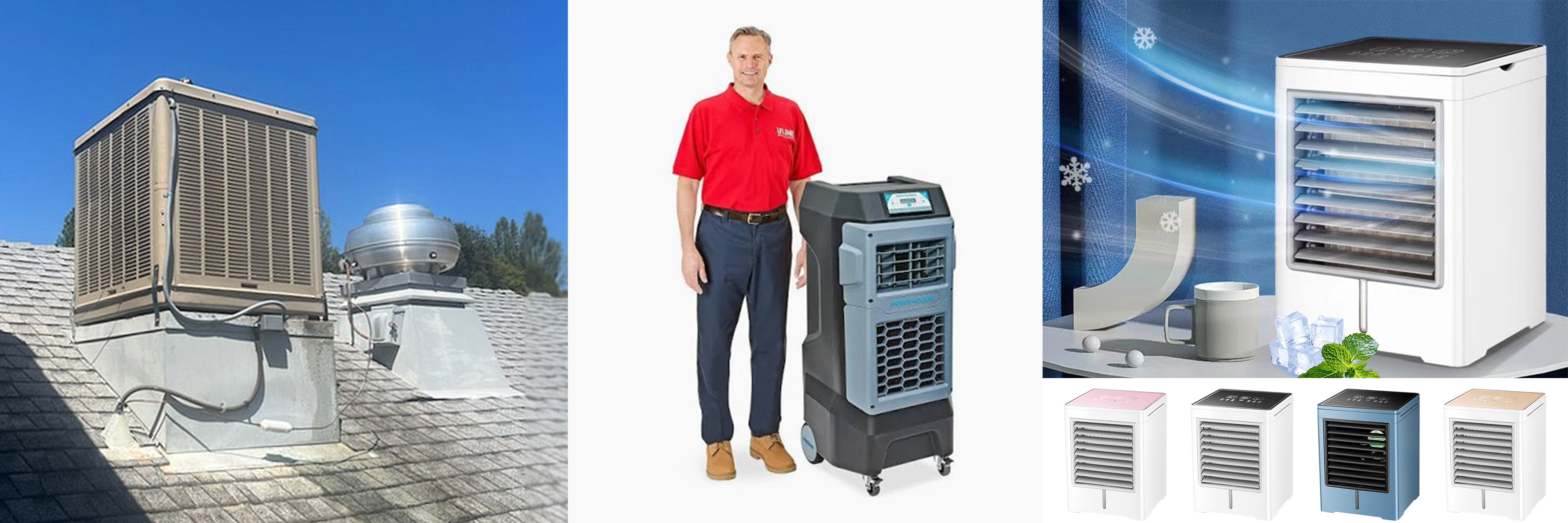
Homeowners back in 2009 were already claiming massive savings from these things: "$20/month to cool a house that would run $160 with conventional A/C."

An eighth of the cost for the same cooling? I had to find out more.
So I started going down the Reddit rabbit hole:

2025, Las Vegas, NV: $350 A/C bill becomes $150 with EC.

2017: $300 electric bill dropped down to $75 in October. Sure, it's the end of summer, but still.

2024, Albuquerque, NM: 40 years with swamp cooler, "year-round budget is $72"
The more I looked, the more evidence I found, even ones that looked 'too good to be true':

2023, Denver: "swamp is WAY better than my AC", $300 A/C bill for 'uneven 78', $150 bill for 'evenly cooled at 72'. (What?!?)
Different states, across different decades, one story: evaporative cooling costs a fraction of what AC does.
So why isn't this mainstream? Could this be the tech Big Utility hopes you never use?
Those forum numbers all came from the big rooftop units — the kind plumbed into old Albuquerque houses like a real AC. I didn't have one of those, and most homes don't either. So I went shopping for the portable kind.

The little ones run about $30 and carry names like "Arctic Air." Arctic? Really? The 3.5 star ratings make me question the "Arctic" claims.
The one big $93 unit on casters is the real deal — 5 gallons, a proper swamp cooler — but it won't fit in a lot of homes.
So I ordered every little one I could find.
While the boxes piled up, I got curious where they were made. It didn't take long to figure out similar coolers sit on AliExpress (China's Amazon) starting at $6.12.

I ran them side by side on my workbench for a month in summer, a thermometer taped in front of each one.
They barely did anything. A few degrees at best.
These cheap coolers prey on people stuck between brutal heat and an overpriced grid.
But I'd seen the savings. The physics was real. The flaw had to be somewhere in the box.
So I pulled one apart.
I took the pad out and poured water on it. I was surprised to find that the pad repelled water, forming water beads like rain on a waxed hood, while most of the pad stays dry.
A 'barely wet' pad can't evaporate anything. And no evaporation means no cooling. Just a fancy fan blowing over a tank of warm water.
The science isn't wrong. The pad didn't get to do the cooling.
I don't have a problem with cheap Chinese products. The problem is when "cheap" is the reason coolers don't cool properly.
So I took matters into my own hands. I built my own EC.
After a winter and a trash can full of ruined pads, I created a colloidal-silica coating that stops water from beading. Now the water spreads thin across the whole pad — more wet pad, more evaporation, more heat leaving the air that blows at you.
I call the coating BeadBreak. The colloidal silica formulation breaks the bead.
The cooler worked. My wife walked in the garage and told me this new cooler needs a name. We decided to name it MistChill™.

- Pulls in hot, dry airThe drier the air, the greater the cooling.
- Through the BeadBreak-coated padNo beading, so the whole pad runs wet, the water evaporates and carries the heat out of the air.
- Cool air comes outAimed right where you're sitting, not wasted on the empty hallway.
The nameplate doesn't lie.
Every cooling unit has one: the little sticker that tells you what it pulls from the wall.
On a central AC unit, the nameplate reads 3,000 to 5,000 watts — running all day, cooling rooms nobody is standing in. And when the utility jacks the rate, that power hog is exactly what they want you running.
The nameplate on mine reads about 65 watts. Roughly one light bulb.
Do the division and it comes out to 50 to 76 times less power — every watt of it going into the room you're in, instead of the whole empty house.
I sold real air conditioners for a living, so I'll say it once, plainly: MistChill doesn't replace central air. It cools the room you're actually in, for pennies, so the central unit runs far less — and in dry heat, that's exactly where it hits hardest.
Big Utility makes the most money when your air conditioner runs all day — and they know it. It's why they'll pay you rebates to put a swamp cooler in, and offer "smart discounts" for the right to cycle your AC off from their office when the grid strains. I was the guy they sent when the shutoff wasn't voluntary. MistChill lets you run it far less — and keep that money yourself.
What makes mine different from the junk?
Set a MistChill next to one of those shelf coolers and I'll be straight with you: same shape. A fan, a tank, a pad. Nobody's reinventing the box.
The difference is the one part you can't see in the product photo:
| The shelf cooler ($26–$90) | MistChill | |
|---|---|---|
| The pad | Bare. Water beads up and rolls back into the tank; most of the pad sits dry. | BeadBreak-treated. The water sheets flat and the whole pad works. |
| The spec | Built to hit a shelf price — and the pad is where they save it. | Built around the pad — the one part they skipped. |
That one part is the whole difference. A dry pad just moves air around; a wet pad actually cools it.
Mine is $89 — more than the junk, a rounding error next to a $10,000 central system, and the only one where somebody actually paid for the pad.
5 Things I Tell My Neighbors When They Ask About MistChill
- It cools the person, not the empty house.Point it where you sit, sleep, or work. The empty bedrooms stop costing you money.
- It sips power.About 65 watts — one old light bulb's worth. A central air conditioner pulls 3,000 to 5,000.
- No install, no $10,000 quote.Unbox it, fill it, plug it in. The ten-grand quote never happens.
- Built for dry heat.Evaporation works hardest in dry desert air. That's physics, and the desert is its home.
- Every hour it runs is an hour the meter isn't spinning for them.That's the point.
I put it in my own house first
I wasn't going to sell anybody something I hadn't lived with. So MistChill went in my own place, through a full Winkelman summer, before it went near a customer. And I kept the same kind of log I used to keep on service calls. Dates and numbers, not adjectives.
Side by side, here's the honest picture:
| MistChill | Central AC | |
|---|---|---|
| Power | ~65 watts | 3,000–5,000 watts |
| Cools | the room you're in | the whole house, empty rooms included |
| To run it | unbox, fill, plug in | about $10,000 to install |
| Best in | dry desert heat | anywhere, at a price |
Individual results vary with your climate, your home, and how you use it.
"Okay, what's the catch?"
Does it replace my AC?
No. Refrigerated air is the only thing that cools a whole house, and I won't pretend otherwise — that's the lie the other guys tell. This lets you run the central unit far less. That's where the savings are.
Isn't this just a swamp cooler?
Same physics — and I'll say it before you do, because I was the guy who got the callback when a rooftop swamp quit in July: evaporative cooling works dry and fades humid. Always has, no exceptions, including mine. Out here it used to be the whole cooling plan — glorious and cheap through the dry months; plenty of old Arizona houses sat at 65 on one for pennies. The difference is the size of the job. A rooftop box has to win against a whole house through ductwork. MistChill has to win three feet of air between the vent and your chair. Small job, small water, small watts — and on dry desert days, which is most of them, it wins.
Is it just a fan?
No. A fan pushes the same hot air around the room. This one runs the air through water first, then hands it to you cooler. A fan, some water, and physics.
Why not just insulate, or buy a newer unit?
If you own your house, insulation is a real fix, and I told customers so for years. The honest version: an afternoon of attic fill is cheap and helps some — but the block walls, the single-pane glass, and the leaky ducts are the five-figure part, and that's the part radiating heat at you till 2 a.m. A new "high-efficiency" system runs twenty, thirty grand now, and I've already told you what's inside them. And if you rent, none of this is even your decision to make. The $89 box is the one cooling decision that's entirely yours — and it works this week, not next spring.
Why so cheap?
Because in my trade, the honest guys had a rule: you try the ten-dollar part before you let anybody sell you the ten-thousand-dollar system. This is the ten-dollar part of your summer bill. No install crew, no middleman, no racket. And if I'm wrong about it in your house, the 90 days means I eat it, not you.
- 90-Day Money-Back
- Free U.S. Shipping
- Ships From Arizona
- Runs on ~65 Watts
How to get one

You've got two choices this summer
Keep doing what they're counting on
The whole house stays on the meter. The empty rooms stay cold. The bill lands, and the family blames itself. I watched that loop from the inside for twelve years.
Cool the room you're actually in
For about what the porch light costs you — and the easiest paycheck Big Utility ever collected quietly walks off their books.
Every good tech I ever worked with tried the cheap part first. This is the cheap part.
I already know which one they're betting you'll pick.
SEE IF MISTCHILL IS STILL IN STOCK$89 · 70% off today · 90-day guaranteeOn your side against the meter,
Marcus Reyes · MistChill